Book Appointment Now

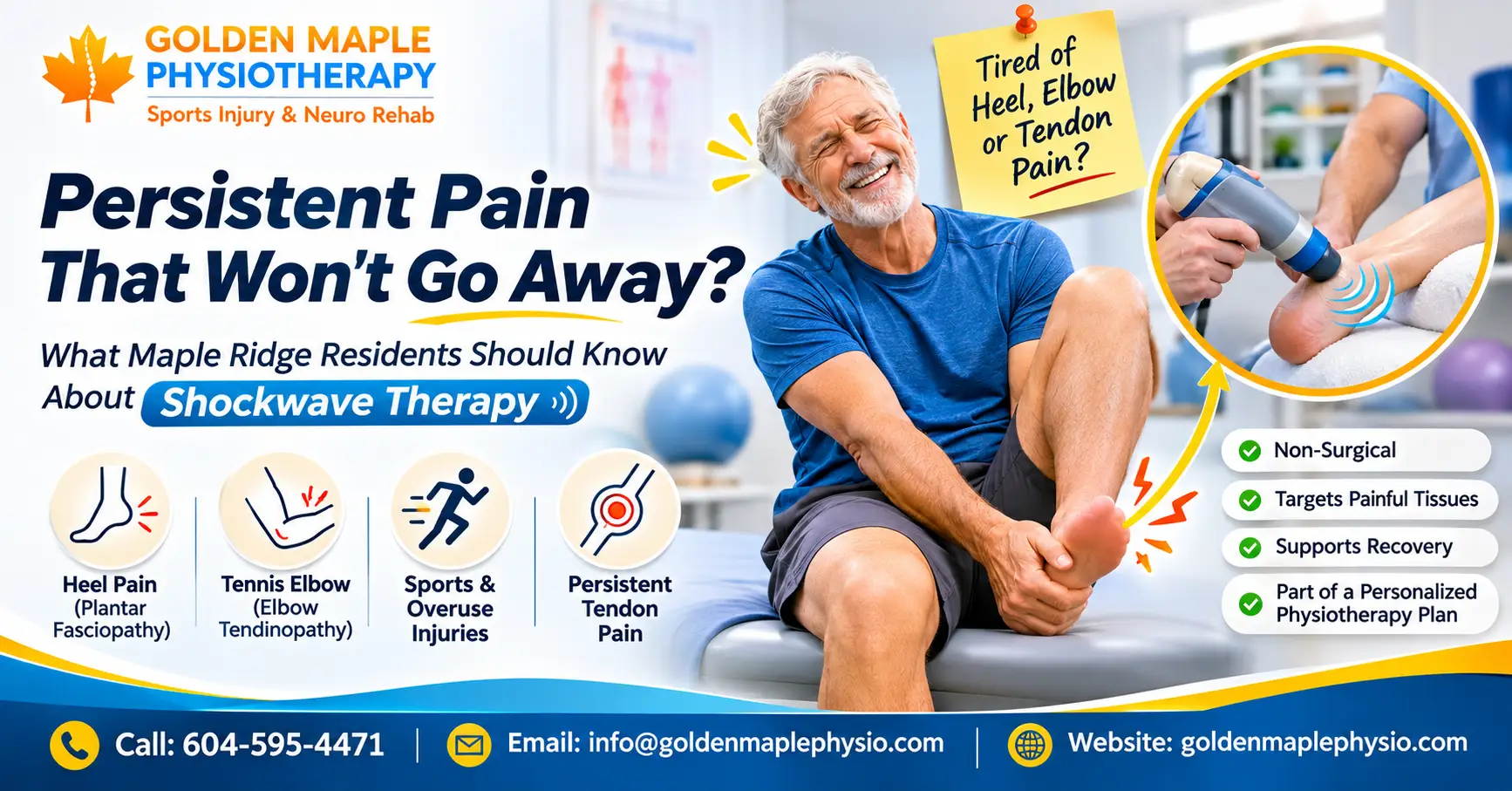
Persistent Pain That Won’t Go Away: What Maple Ridge Residents Should Know About Shockwave Therapy.
- On
- Inblog
Imagine getting out of bed in the morning and feeling a sharp pain in your heel. You try to ignore it, thinking it will disappear after a few days. But weeks later, walking, climbing stairs and even standing for long periods still feel uncomfortable.
For some people, persistent tendon and soft tissue pain can gradually interfere with everyday activities. Whether you are an older adult, a recreational runner or someone who spends long hours working, ongoing pain deserves proper attention. Shockwave Therapy in Maple Ridge is one treatment option that may be considered for certain persistent musculoskeletal conditions.
But how does this treatment work? Can acoustic waves influence painful tissues? And what does current medical research actually say?
Let’s explore the science, common conditions, treatment expectations and evidence behind this approach.
Why Does Some Pain Continue for Months?
Not every injury improves simply by resting. Tendons and other connective tissues can remain sensitive when they are exposed to repeated loading, sudden increases in activity or insufficient recovery.
Consider three everyday situations.
- The older adult experiencing morning heel pain
A person wakes up and experiences discomfort around the heel during the first few steps. The pain may gradually ease after moving around but returns after prolonged standing.
One possible explanation is plantar fasciopathy, a condition involving the connective tissue supporting the foot arch. An appropriate assessment can determine whether plantar fasciopathy treatment in Maple Ridge should include strengthening, activity modification or additional treatment options.
- The recreational runner with recurring Achilles pain
A runner increases their weekly distance and starts experiencing discomfort around the Achilles tendon. Continuing the same training routine without adjusting the workload may aggravate symptoms.
Achilles tendinopathy requires an individual rehabilitation programme. Progressive tendon loading is an important treatment component, and shockwave therapy should not automatically be considered the preferred solution.
- The working professional experiencing elbow pain
A person who regularly lifts objects, uses tools or performs repetitive hand movements develops discomfort around the outside of the elbow.
This may be associated with lateral elbow tendinopathy, commonly called tennis elbow. In selected cases, shockwave therapy for tennis elbow may be discussed as part of a wider treatment plan.
These examples highlight why identifying the actual source of pain is more important than simply treating the painful area.
What Is Shockwave Therapy and How Does It Work?
For people researching Shockwave Therapy in Maple Ridge, understanding the treatment mechanism is an important first step.
Shockwave therapy uses controlled acoustic pressure waves delivered through a handheld applicator to a selected area of the body.
There are two commonly discussed forms:
Focused shockwave therapy: Concentrates acoustic energy at a selected depth within the tissue.
Radial pressure wave therapy: Distributes pressure waves outward from the applicator, with energy generally concentrated closer to the surface.
Although the terms are often used interchangeably in everyday clinic descriptions, they are not technically identical.
The mechanical stimulus can influence local biological and pain-related responses. Researchers continue to investigate the precise mechanisms and how different treatment parameters influence outcomes.
A typical treatment process involves:
- Identifying the affected area through clinical assessment.
- Applying an appropriate amount of acoustic energy using a treatment device.
- Monitoring patient comfort and response.
- Combining treatment with suitable rehabilitation exercises when indicated.
- Reviewing functional progress and adjusting the treatment plan.
It is important not to assume that shockwave therapy instantly repairs damaged tissue or guarantees pain elimination.
Which Conditions May Benefit From Shockwave Therapy?
Research has investigated shockwave treatment for several musculoskeletal conditions, although the strength of evidence differs between diagnoses.
Plantar fasciopathy: Some people with persistent heel pain may experience improvements in pain and function following appropriate shockwave treatment.
Lateral elbow tendinopathy: Acoustic pressure wave treatment may be considered for selected patients experiencing persistent elbow tendon pain.
Rotator cuff tendinopathy: Certain shoulder tendon conditions have been investigated as potential indications.
Patellar tendinopathy: Research findings remain mixed, and shockwave treatment should not automatically replace progressive strengthening.
Achilles tendinopathy: Evidence is less convincing, and recent research does not support its routine use for this condition.
People searching for shockwave treatment for heel pain should also understand that heel discomfort can have several causes. Nerve irritation, stress injuries and other foot conditions may require completely different treatment approaches.
What Does Medical Research Say?
Medical evidence is essential when evaluating any physiotherapy treatment.
A 2025 international modified Delphi study published in the British Journal of Sports Medicine examined recommendations for using extracorporeal shockwave therapy in sports medicine.
The expert panel discussed appropriate clinical indications, treatment terminology, energy levels and application protocols. It also highlighted the importance of distinguishing focused shockwave therapy from radial pressure wave therapy.
This was an expert consensus study, not a clinical trial proving that treatment works for every condition.
Research reference:
https://pubmed.ncbi.nlm.nih.gov/40032293/
A 2023 systematic review and meta-analysis published in Frontiers in Immunology examined shockwave therapy for plantar fasciitis, Achilles tendinopathy and patellar tendinopathy.
The findings suggested stronger evidence of improvements in pain and function for plantar fasciitis, while the evidence for Achilles and patellar tendinopathy was less convincing.
Research reference:
https://pubmed.ncbi.nlm.nih.gov/37662911/
More recently, a 2026 systematic review and meta-analysis published in the Journal of Orthopaedic & Sports Physical Therapy examined shockwave therapy for midportion and insertional Achilles tendinopathy.
The researchers found no clinically meaningful overall benefit and concluded that shockwave therapy should not be considered a routine treatment for these conditions.
Research reference:
https://pubmed.ncbi.nlm.nih.gov/42063301
What should patients understand?
Shockwave therapy is not a universal solution for tendon pain. Its suitability depends on the diagnosis, research evidence, individual circumstances and the overall rehabilitation strategy.
What Are the Potential Benefits?
When clinically appropriate, shockwave treatment may offer several potential advantages:
- Non-invasive application without surgical incisions.
- May improve pain and function in selected conditions.
- Can be incorporated into a broader physiotherapy programme.
- May help some patients progress with movement and rehabilitation.
- Does not require needles to deliver acoustic pressure waves.
- Can be considered when persistent symptoms have not improved sufficiently with initial conservative management.
Some patients experience temporary tenderness, redness or discomfort following treatment. Outcomes vary, and improvement is not guaranteed.
What Should You Expect During a Treatment Session?
When considering Shockwave Therapy in Maple Ridge, it helps to understand what happens before, during and after treatment.
Initial assessment: Your physiotherapist reviews your symptoms, medical history and movement limitations.
Treatment planning: The clinician determines whether shockwave treatment is suitable for your particular condition.
Treatment application: The device is applied to the selected area using an appropriate treatment protocol.
Rehabilitation guidance: Exercises, strengthening and activity modifications may be recommended according to your needs.
Progress assessment: Your symptoms and functional abilities are reviewed to determine whether the treatment plan should continue or change.
The number of sessions depends on the condition, treatment method and individual response. There is no guaranteed session count that works for everyone.
Who Should Consider Shockwave Treatment?
People experiencing selected persistent tendon or fascia conditions may benefit from discussing this treatment option with a qualified healthcare professional.
An assessment is particularly important when:
- Heel pain continues to interfere with walking.
- Elbow discomfort affects gripping or lifting.
- Certain tendon-related symptoms persist despite appropriate rehabilitation.
- Pain limits sports, exercise or everyday activities.
- A clinician identifies a condition for which research supports considering shockwave treatment.
Some medical conditions and circumstances may require avoiding treatment or taking additional precautions. These include certain blood-clotting conditions, pregnancy depending on the treatment area, active infection, open wounds and malignancy in the proposed treatment area.
Always disclose your medical history and medications before treatment.
Why Should Shockwave Therapy Be Combined With Rehabilitation?
A treatment device alone cannot address every factor contributing to persistent pain.
For example, someone with plantar fascia pain may need calf and foot strengthening, appropriate footwear guidance and gradual activity progression.
Someone with elbow tendinopathy may require progressive strengthening and adjustments to repetitive work activities.
This is why chronic tendon pain physiotherapy in Maple Ridge should focus on more than temporary symptom management.
At Golden Maple Physiotherapy, patients can explore available physiotherapy services and discuss their movement-related concerns as part of an individual care plan.
Relevant services include:
- Shockwave Therapy: https://goldenmaplephysio.com/shockwave-therapy-in-maple/
- Sports Injury Rehabilitation: https://goldenmaplephysio.com/sports-injury-rehabilitation/
- Manual Therapy: https://goldenmaplephysio.com/manual-therapy/
Each service has a different purpose, and the appropriate combination depends on the patient’s assessment and rehabilitation goals.
FAQ
Is shockwave therapy painful?
Some people experience temporary discomfort during treatment. The intensity can be adjusted according to the treatment protocol and individual tolerance.
How many sessions are required?
The number varies depending on the diagnosis, treatment method and individual response. Your clinician can discuss expected treatment intervals after assessment.
Can shockwave therapy help plantar fasciitis?
Research suggests that it may improve pain and function in selected people with persistent plantar fasciopathy. It should be considered alongside appropriate rehabilitation.
Can I return to normal activities after treatment?
Activity recommendations depend on the treated condition and treatment protocol. Your physiotherapist can advise whether temporary activity modifications are necessary.
Is shockwave therapy suitable for Achilles tendon pain?
It is not recommended as a routine treatment based on the 2026 systematic review. Progressive rehabilitation and individual clinical assessment should guide treatment decisions.
Does shockwave therapy replace physiotherapy exercises?
No. It should not automatically replace strengthening, movement training or other evidence-informed rehabilitation strategies.
Take the First Step Towards Understanding Your Pain
Persistent pain can gradually affect walking, working, exercising and enjoying everyday activities. Understanding its cause is the first step towards making informed treatment decisions.
If you are considering Shockwave Therapy in Maple Ridge, remember that the right treatment starts with an accurate assessment, realistic expectations and an individual rehabilitation plan.
Golden Maple Physiotherapy encourages patients to understand their treatment options and seek appropriate professional guidance for persistent musculoskeletal discomfort.
For more information about Shockwave Therapy in Maple Ridge and available physiotherapy services, contact Golden Maple Physiotherapy.
Golden Maple Physiotherapy
Call: 604-595-4471
Email: [email protected]
Website: https://goldenmaplephysio.com/
Newsletter Updates
Enter your email address below and subscribe to our newsletter